

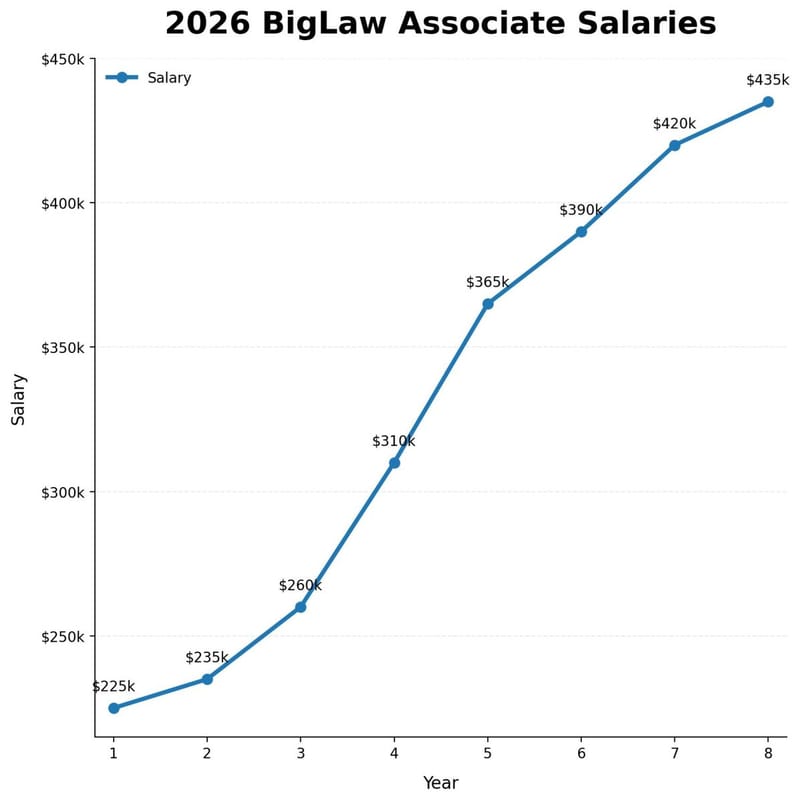
The Cravath scale contains a hidden insight lying in plain sight: your career control peaks between years 3-5, then rapidly declines. Put it in a chart and the insight reveals itself.
The Salary Story
Look at the rate the salary changes:
- Years 1-2: Trickle up. You're still learning, the firm is testing fit.
- Years 3-5: Acceleration. Firms have invested in you, and you can walk away with portable skills. So they pay up to keep that investment.
- Years 6-8: Plateau. You're entrenched. Moving firms means rebuilding relationships, proving partnership potential from scratch, and competing against internal candidates. Firms know this, and compensation slows because of reduced leverage.
Peak Leverage
Charting salary reveals a hidden message: your strongest position to improve fit, negotiate a bonus, or redirect your career is between years 3-5.
The problem is that many associates wait too long to evaluate their options. By the time they realize they're not on the right track, inertia has set in. If you're considering a move, understanding why working with multiple recruiters backfires can help you navigate the process more effectively.
You Have Control
The chart tells a story you don't hear much as a biglaw associate: you have control.
Your window of maximum leverage is finite. Years 3-5 represent the sweet spot where your skills are portable, your options are open, and firms are willing to pay to keep you. Don't let that window close without at least evaluating what's out there.
The associates who thrive are the ones who take an active role in shaping their careers during this critical period.
If you're a mid-level associate wondering about your options, now is the time to start the conversation.